Most SEO software stops at insight. It tells you what's wrong, hands you a dashboard, and leaves the hard part — actually doing the work, consistently, on time — to you. The thing that closes that gap, and the single most important concept in an autonomous SEO platform, is the Standard Operating Procedure: the SOP.
What an SOP actually is
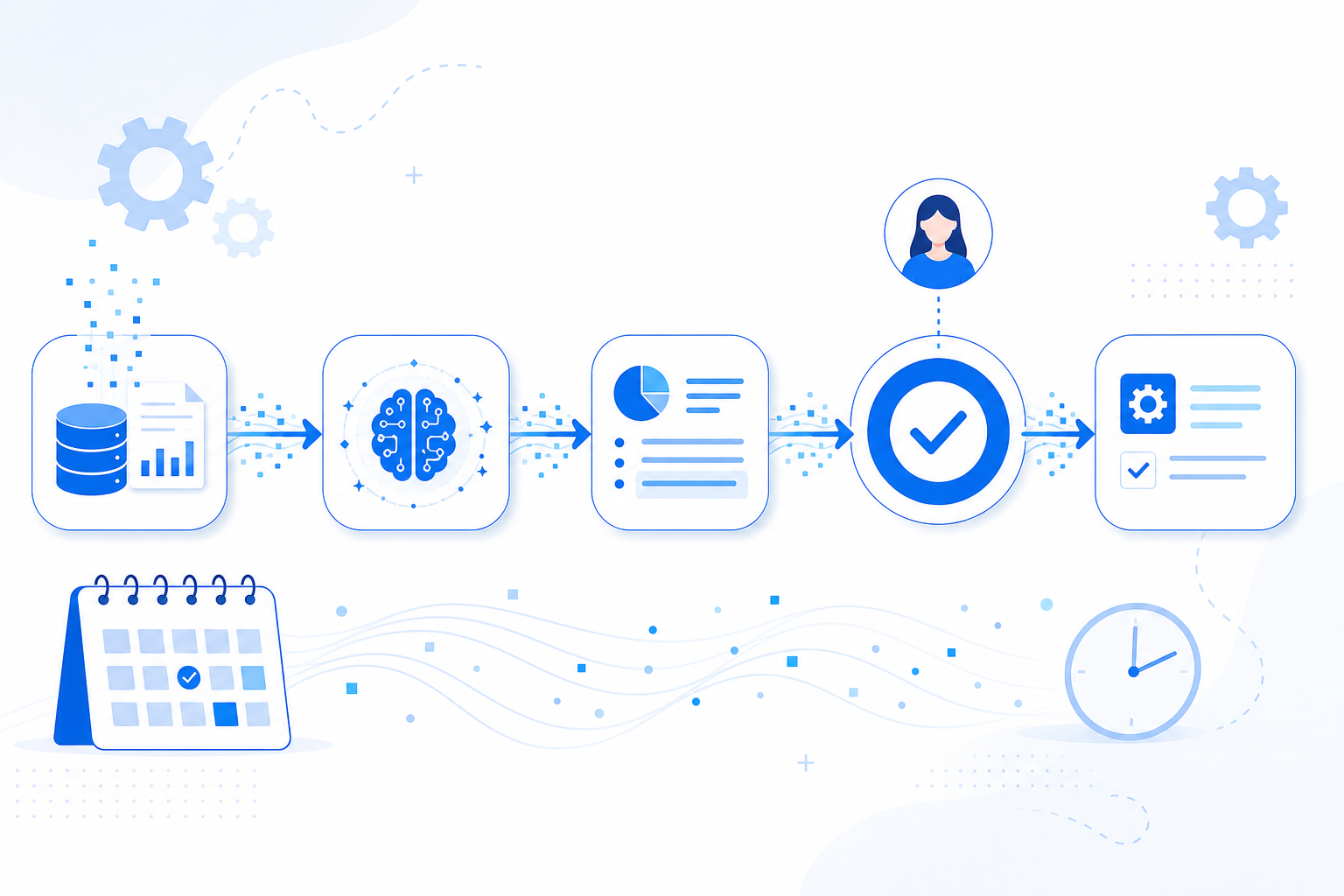
An SOP packages a multi-step SEO playbook into a repeatable, automated workflow. Instead of a person manually pulling data, interpreting it, deciding what to do, and creating tasks, the SOP chains those steps together so they run as one motion: data pull → AI analysis → recommended actions → tasks. It can run on demand when you click a button, or on a schedule — every Monday at 9 AM, say — without anyone remembering to start it.
If you've ever written an internal doc that begins "Step 1: export the rankings; Step 2: check which dropped; Step 3: brief the writers…" — that's a playbook. An SOP is that playbook made executable, so the agent runs it instead of a human.
An SOP is the difference between a tool that tells you what to do and an agent that does it — the same best-practice way, every time.
Why SOPs are the core, not a feature
A platform can have brilliant individual modules — keyword intelligence, technical audits, competitor analysis, behavior analytics — and still leave you doing all the coordination by hand. SOPs are what make those modules compound. They're the connective tissue that turns nine separate capabilities into one autonomous agent.
Three reasons they matter more than any single module:
- Consistency. Quality stops depending on which specialist is free that week. The SOP applies the same expert steps every run.
- Speed. Insight becomes action in minutes, not days. There's no hand-off lag between "we noticed" and "we shipped a fix."
- Scale. One person can oversee dozens of sites when the routine work runs itself and only escalates for approval.
The anatomy of an SOP
A production-grade SOP isn't just "run these steps." It's built with the controls that make hands-off automation safe:
- Approval gates. Sensitive steps — content rewrites, link disavows — pause and wait for a human to sign off via Slack or email before anything goes live.
- Stop / resume. You can pause a run mid-flight and resume it later without losing the work already completed.
- Audit logging. Every decision and action is recorded, so the whole run is traceable and reversible.
- Scheduling. Cron-style schedules mean the right playbook fires at the right cadence automatically.
- Notifications. The team is told when a run completes and whenever it's waiting at a gate.
Deterministic-first. Inside each SOP, rules and validation run in code before any paid AI is involved — improving reliability and keeping costs predictable. AI is used for judgment, not busywork.
The seven built-in playbooks
A good platform ships with playbooks you can run on day one. The seven built-in SOPs cover the recurring backbone of SEO operations:
- On-Page Optimization Playbook — crawl, analyze, generate fixes, create tasks, notify.
- Technical SEO Health Check — crawl, check Core Web Vitals, analyze redirects, generate a fix plan, email the report.
- Competitor Response Playbook — scan rankings, detect new keywords, analyze gaps, generate briefs, alert the team.
- Content Decay Prevention — detect declining pages, run SERP analysis, generate refresh plans, schedule follow-up.
- Link Building Outreach (Tuesdays 8 AM) — gap analysis, find prospects, personalize outreach emails, create campaign tasks.
- UX Optimization from Behavior (Wednesdays 7 AM) — behavior snapshot, detect anomalies, generate UX fixes, create developer tasks.
- Weekly SEO Executive Report (Mondays 9 AM) — aggregate data, detect anomalies, write the summary, create investigation tasks, email stakeholders.
And because SOPs are composable, these are a starting point — you can chain any module's data, analysis and actions into a custom playbook that matches how your team actually works.
A worked example: Behavior-Driven Refresh
The clearest way to understand an SOP is to watch one cross module boundaries. The Behavior-Driven Refresh playbook connects behavior analytics to content optimization:
- It pulls user session and heatmap data for a page.
- AI identifies the specific friction points — where users rage-click, where they drop off.
- It drafts content rewrites to address that friction.
- It pauses at an approval gate and sends the drafts to Slack for sign-off.
- Once approved, it captures the change as a task and re-verifies the page on the next cycle.
No human had to remember to check the recordings, interpret them, write the brief, or chase an approval. The SOP did the routine; the human did the one thing only they should — say yes.
The goal isn't to remove humans from the loop. It's to remove humans from the busywork, so their judgment is spent only where it counts.
Automation you can actually trust
The fear with "an agent that acts" is always control. SOPs answer it by design: approval gates keep humans in command of anything sensitive, audit logs make every action accountable, reversibility means mistakes aren't permanent, and stop/resume means you're never locked into a run. Autonomy and oversight aren't a trade-off here — they're built together.
That's why SOPs are the heart of an autonomous SEO platform. Modules give you capability; SOPs give you leverage. They're the mechanism that finally turns the entire SEO operation — data, analysis, decisions, content changes and reporting — into a workflow that runs itself, while you stay firmly in control.