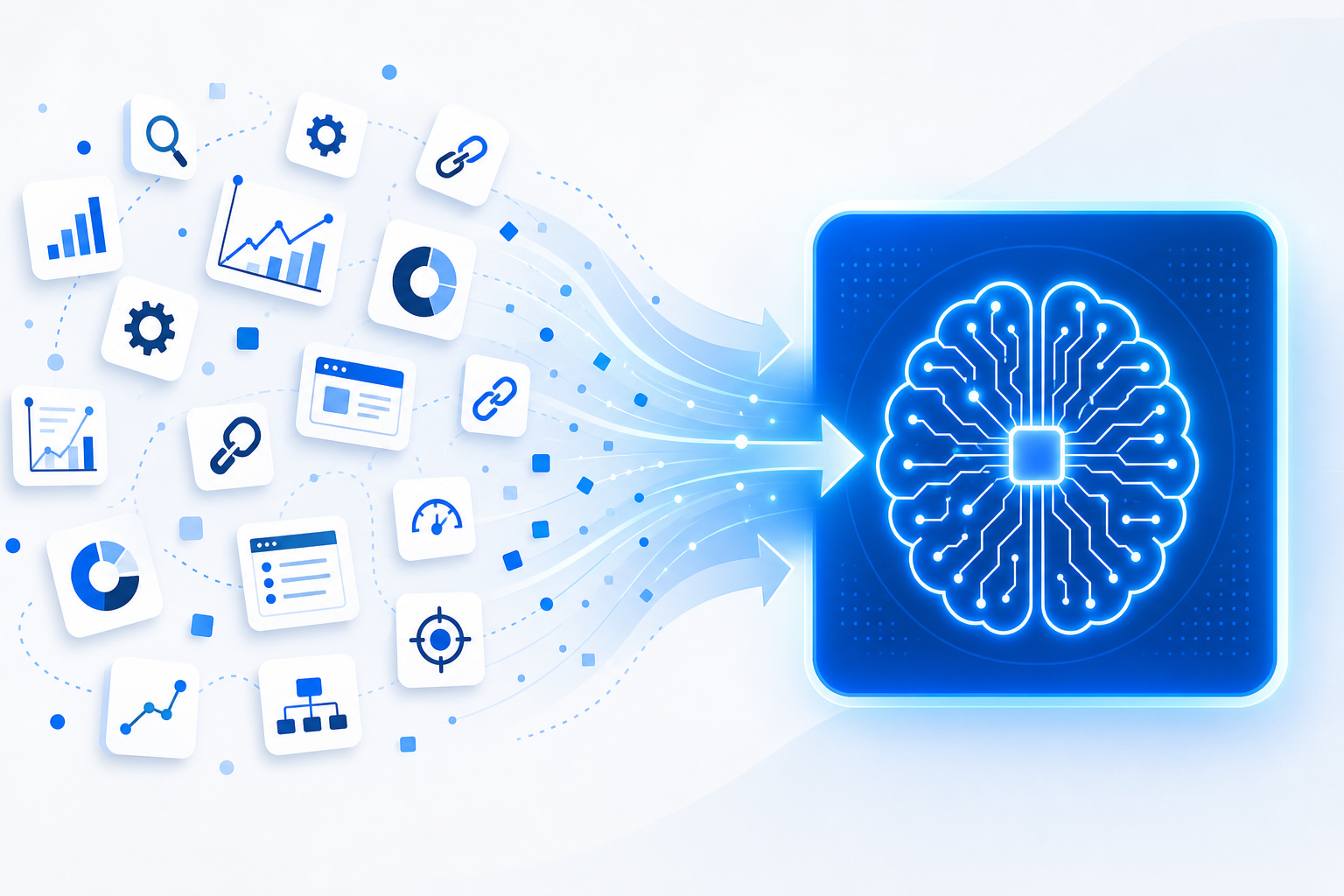
Ask any SEO team what they're short on and almost none will say "data." We are drowning in it. Rank trackers, crawlers, backlink databases, analytics, heatmaps, outreach platforms — each pours out dashboards, exports and alerts. The modern SEO problem isn't a lack of insight. It's the chasm between insight and action.
The real bottleneck is execution
Consider a typical week. A rank tracker flags ten keywords slipping from page one. A crawler surfaces a hundred new issues. The backlink tool notices a competitor's fresh links. Behavior recordings hint at a confusing landing page. Every one of these is a genuine insight — and every one of them is inert until a human reads it, decides what to do, writes a ticket, and someone executes.
That translation layer — from "here's what the data says" to "here's the optimized meta description, the redirect map, the content brief, the outreach email" — is where the time goes. It's slow, it's expensive, and its quality swings with whichever specialist happens to be available that week.
Teams pay for insight, then spend their most expensive hours converting it into decisions and tickets. The data was never the constraint.
The hidden cost of a fragmented stack
Beyond the analyst hours, fragmentation imposes three quiet taxes:
- Context-switching. Ten tools mean ten logins, ten data models and ten mental models. Insights that should combine — behavior plus rankings plus content — stay siloed because no single tool sees all of them.
- Inconsistency. Without a shared playbook, the same situation gets handled differently depending on who picks it up. Best practice lives in people's heads, not in the system.
- Reporting overhead. Every month, senior people pull numbers from scattered sources into a deck — work that produces no new value and crowds out actual strategy.
What an AI executive agent actually does
An AI executive agent collapses that stack into a single workspace and, crucially, changes its job description. Instead of presenting data and stopping, it acts on it — the way a senior SEO would.
Concretely, that means the agent doesn't just say "this title tag is weak." It generates the optimized title, with reasoning. It doesn't just flag a 404 — it proposes the redirect. It doesn't just note a keyword gap — it drafts the content brief and the outreach email. Each output is specific, ready to review, and one approval away from being a real task.
The modules share one brain
Because everything lives in one place, the modules compound. Keywords feed topic clusters. On-page audits feed the knowledge graph. Behavior signals feed content refreshes. An insight discovered in one module becomes an input to another — something a fragmented stack structurally cannot do.
The action loop: monitor, analyze, recommend, approve, act
Under the hood, the agent runs a continuous loop:
- Monitor — ingest data from every connected source on a schedule.
- Analyze — run deterministic rules first, then apply AI to interpret what actually matters.
- Recommend — generate the specific fix, not just the finding.
- Approve — pause sensitive actions at a human gate via Slack or email.
- Act — turn approved recommendations into tasks and changes, then re-verify.
The most valuable part is that these loops can be packaged as repeatable playbooks — Standard Operating Procedures — that run on demand or on a schedule. A weekly executive report writes itself every Monday. A link-building outreach campaign assembles itself every Tuesday. The work that used to require a calendar reminder and a free afternoon now just happens.
Deterministic-first by design. Rules and validation run in code before any paid AI is involved — which improves reliability and keeps costs predictable. AI is used where judgment is needed, not as a blunt instrument.
Automation without losing control
The natural worry about an "agent that acts" is loss of control. The answer is that autonomy and oversight aren't opposites — they're designed together.
- Approval gates mean nothing sensitive ships without a human sign-off.
- Audit logging records every automated decision, so you can always see what happened and why.
- Reversibility means actions can be undone.
- Stop / resume lets you pause a run and pick it back up without losing completed work.
The result is automation you can actually trust in production: hands-off where it's safe, human-gated where it matters.
Where to start
You don't have to rip out your stack on day one. The pragmatic path is to pick the workflows that cost the most human time and automate those first — usually reporting, technical audits and competitor monitoring. As confidence grows, you widen the agent's remit and let scheduled SOPs carry more of the load.
The endpoint isn't "fewer dashboards." It's a fundamentally different operating model, where insight and action are the same step — and your team spends its time on strategy instead of translation.