Your analytics can tell you that 64% of visitors leave a page without converting. What they almost never tell you is why. That "why" — the moment a user got confused, hit a dead end, or gave up scrolling — is some of the richest content intelligence you have. And most teams never act on it.
The qualitative blind spot
Traditional SEO lives in aggregate numbers: sessions, bounce rate, average position. Those are essential, but they're lagging and impersonal. They describe the outcome of a bad experience without ever explaining the experience itself.
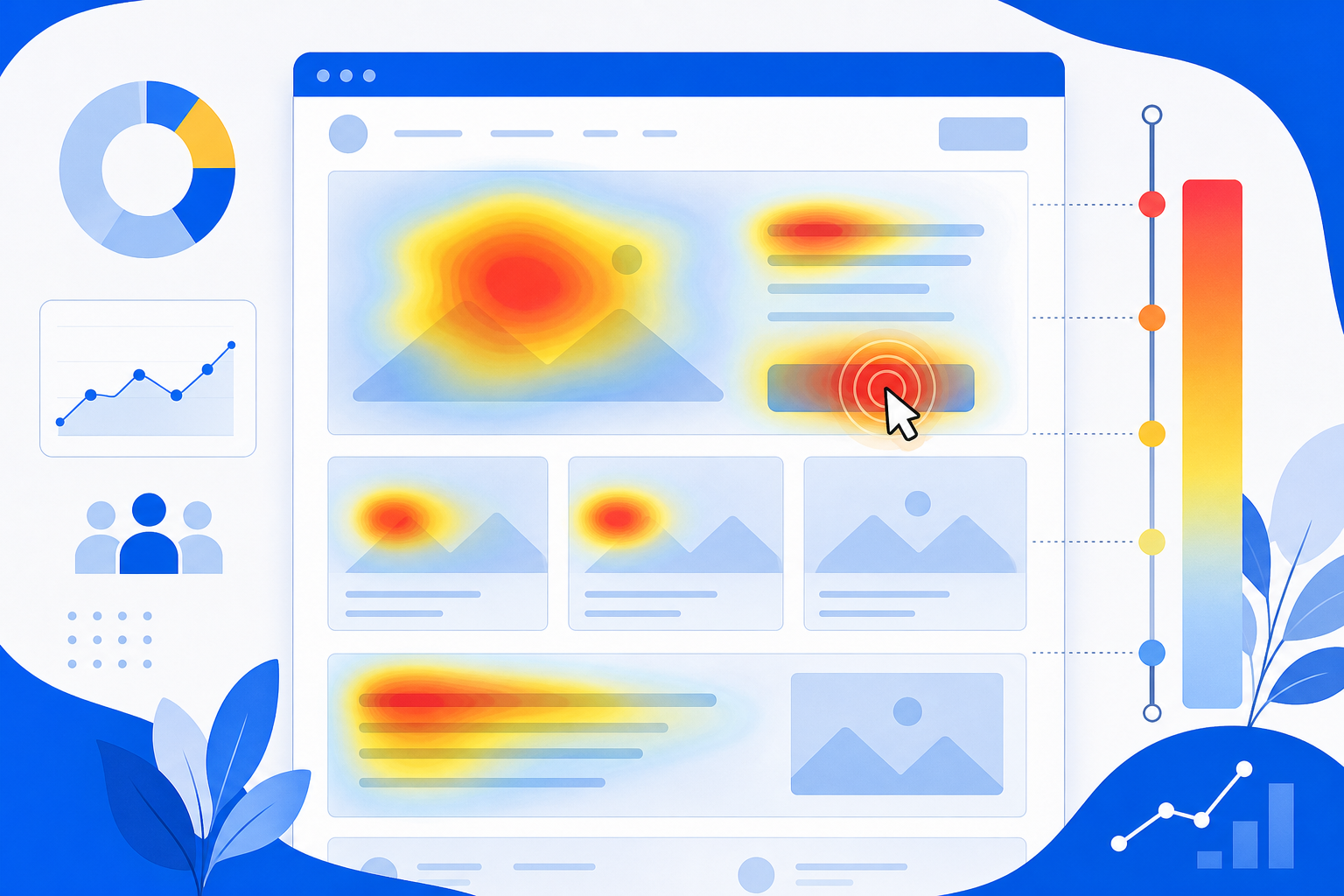
Session recordings and heatmaps fill that gap. They show you the actual cursor movements, the clicks that went nowhere, the precise scroll depth where attention died. This is qualitative behavior data, and when you connect it to your content, it stops being a UX curiosity and becomes a direct input to your SEO strategy.
Bounce rate tells you a page failed. Behavior data tells you exactly where, and exactly why — which is the part you can actually fix.
The signals that matter most
- Rage clicks. Rapid, repeated clicks on the same element — a sign something looks interactive but isn't, or isn't responding. Often a broken CTA or a misleading design cue.
- Dead clicks. Clicks on non-interactive elements. Users expected something to happen and nothing did.
- Scroll depth and drop-off. The exact point where most users stop reading. If 70% never reach your key content, that content effectively doesn't exist.
- Friction and hesitation. Erratic movement, back-and-forth scrolling and long pauses that signal confusion.
Why behavior is an SEO signal, not just a UX one
It's tempting to file all of this under "UX" and move on. That's a mistake. Search engines increasingly reward content that satisfies the user's intent, and behavior data is your clearest proxy for satisfaction. A page where users rage-click the navigation and bounce at 40% scroll is a page that isn't meeting intent — and that signal shows up downstream in engagement and, eventually, rankings.
More practically, behavior pinpoints which content to fix and how. A thin-content page might be underperforming not because it's short, but because the answer users need is buried below a fold they never reach. That's a structural content problem you'd never diagnose from rankings alone.
From raw recordings to an AI digest
The catch with behavior data is volume. Nobody has time to watch hundreds of session recordings. The breakthrough is letting an AI digest do the watching — converting raw clicks, scrolls and friction into a short list of prioritized insights with concrete rewrite hints.
A good digest doesn't just say "users bounce on the pricing page." It says: "On the pricing page, 58% drop off before the comparison table; rage clicks cluster on the FAQ accordion (likely perceived as broken); recommend moving the table above the fold and converting the FAQ to expanded text." That's a content brief, derived entirely from behavior.
Behavior feeds content, directly. Friction findings shouldn't sit in a separate UX backlog — they should flow straight into your content-refresh queue, where they belong.
Turning friction into content refreshes
Once you have a behavior-derived brief, the refresh almost writes itself. Common high-impact moves:
- Reorder for intent. Move the content users actually want above the drop-off point.
- Fix false affordances. Anything users rage-click should either work or stop looking clickable.
- Expand the thin parts. Where hesitation clusters, users need more — examples, clarity, an answer to the unasked question.
- Cut the friction. Remove interstitials, simplify forms, shorten the path to the payoff.
Each of these is measurable: re-record after the change and watch whether the drop-off point moves and the rage clicks disappear.
Make it a recurring workflow
The teams that win with behavior data don't treat it as an occasional research project. They wire it into a recurring playbook: pull the latest session and heatmap data, run the AI digest, surface the top friction points, draft the rewrites, route them for approval, and capture the change as a task — then re-verify on the next cycle.
Done this way, "why users bounce" stops being a mystery you investigate once a quarter and becomes a continuously closing loop — one where every bounce is just the next content improvement waiting to happen.